
How much do you need to retire? The answer depends on your lifestyle, expected expenses, retirement age, life expectancy, and investment returns. By estimating your future income needs and accounting for inflation, you can calculate a retirement savings target that supports your desired standard of living. Understanding this number is the first step toward building a secure and sustainable retirement plan.
How much do you need to retire? The answer depends on your lifestyle, expected expenses, retirement age, life expectancy, and investment returns. By estimating your future income needs and accounting for inflation, you can calculate a retirement savings target that supports your desired standard of living. Understanding this number is the first step toward building a secure and sustainable retirement plan.


Most investors need an annual retirement income of around $40,000 to $100,000 to maintain their current standard of living. A common target is accumulating 25 times your annual expenses, which aligns with the classic 4% withdrawal rule. However, your personalized number depends heavily on your lifestyle, health factors, and the exact age you choose to stop working. Use the principles below and our retirement calculator to find your target and build your strategy.
Before building a customized strategy, consider these foundational rules of thumb:
Key Takeaways
-
The quickest rule of thumb dictates saving 25x your annual expenses, or about 10x your annual income by the time you retire.
- You can determine your own amount by estimating annual expenses, subtracting fixed income, and multiplying the remaining gap by 25.
- Three primary factors change your required savings: your retirement age, desired lifestyle, and projected lifespan.
How much do you need to retire?
A typical goal for most investors is saving roughly 25 times their annual retirement expenses, or alternatively, 10 times their annual income by age 67. Determining exactly how much you need to retire usually starts with these broad benchmarks.
Many clients aim for a retirement portfolio ranging between $500k and $1.5M. The two most common anchoring methods are the salary multiple and the so-called 25x rule. A useful separate benchmark is comfortable retirement income, which as of 2026 is often framed in tiers:
- basic retirement may require around $40k per year
- comfortable retirement around $60k–$70k per year
- luxury retirement $100k+ per year
Of course those numbers depend on lifestyle, location, and household needs. Also, due to the rising global inflation trend, those numbers may change significantly 10, 20 or 30 years ahead.
- Age 30: Aim to have around 1x your annual salary saved for retirement.
- Age 40: Aim to have around 3x your annual salary saved.
- Age 50: Aim to have around 6x your annual salary saved.
- Age 60: Aim to have around 8x your annual salary saved.
- Age 67: Aim to have around 10x your annual salary saved by retirement age.
These targets assume retirement around age 67, steady saving, long-term investing, and support from savings plus government benefits. They are not universal. The right amount depends on retirement age, returns, inflation, life expectancy, spending, pensions, taxes, and other assets. Someone retiring at 55 may need far more than 10× salary, while someone retiring at 70 with a strong pension may need less.
|
|
Which rule of thumb should you use to start?
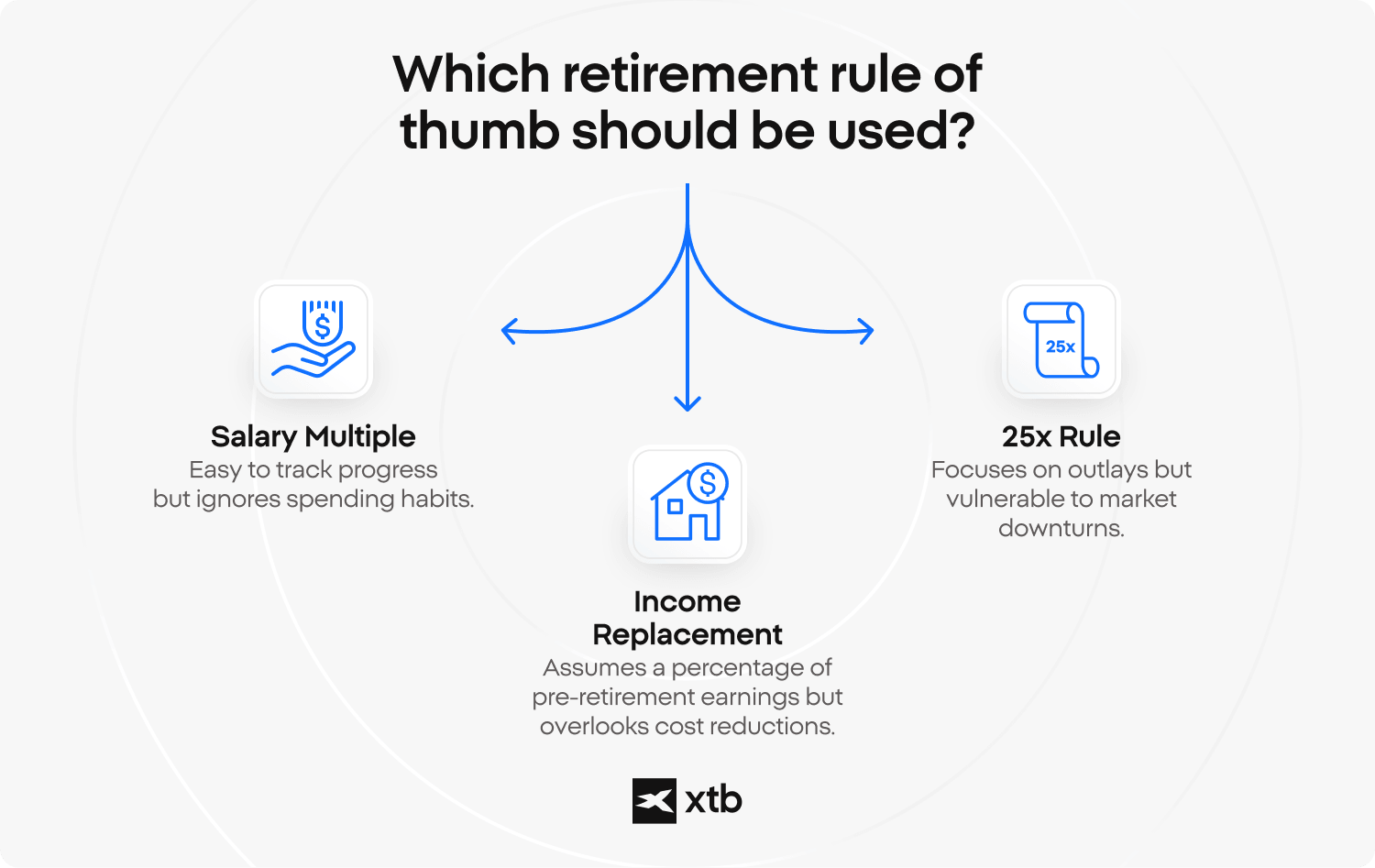
Use the Salary Multiple if you want a quick progress tracker tied to income. Use the 25x Rule if you can estimate your retirement spending. Use Income Replacement if you only know your current earnings. When figuring out how much to retire, it is best to understand the mechanisms behind the most popular shortcuts.
Investors generally choose between three primary shortcuts to anchor their goals. The Salary Multiple serves as an easy progress tracker by calculating savings as a multiple of current income, though it fails to account for actual spending habits.
Conversely, The 25x Rule focuses heavily on outlays, assuming your portfolio can sustain a 4% inflation-adjusted withdrawal rate - a strategy that can struggle if you encounter an immediate market downturn. The Income Replacement guideline assumes you will need roughly 55% to 80% of your pre-retirement income, according to JPMorgan and Fidelity Investment research.
How do you calculate your own retirement number?
You can calculate your personal retirement target in three distinct steps: estimate your annual expenses, subtract any fixed income, and multiply the remaining gap by 25. Building a personalized plan offers far more clarity than generic rules.
- Estimate your annual retirement expenses: A practical starting point is assuming you will spend roughly 70% of your current expenses during your retirement years.
- Subtract your fixed income: Deduct guaranteed income sources from your total expenses. This includes state pensions, or established rental income.
- Calculate your remaining funding gap: Identify the exact net annual deficit that your investment portfolio must cover.
- Multiply the gap: Multiply your remaining income gap by 25 (or divide it by 0.04). The result represents the total portfolio value you need to accumulate.
|
|
Estimate your portfolio based on your desired retirement income
Another way to estimate your retirement savings goal is to start with the annual income you want to generate in retirement. Using the 4% rule, you can estimate the required portfolio by multiplying your desired yearly income by 25.
|
|
|
|
|
|
|
|
|
|
|
|
|
|
|
|
|
|
This method is useful for people who already have a clear retirement income target. However, the 4% rule is a general planning guideline rather than a guarantee. The amount you actually need may differ depending on your expected investment returns, taxes, inflation, life expectancy, and withdrawal strategy.
What changes how much you need?
The exact same person might need vastly different portfolio amounts depending on their retirement age, expected lifestyle, and overall lifespan. Understanding how much money you need to retire means analyzing the variables that directly impact your capital outflow. Your timeline matters immensely; an early exit means your portfolio must sustain you for longer. Additionally, your location dictates your baseline cost of living.
If you deploy your capital into long-term growth instruments, such as understanding what is an ETF to capture market indexes, higher-than-expected returns may accelerate your timeline to early retirement.
The Impact of Inflation
Real purchasing power drops significantly over time due to inflation. An item that costs $100 today might cost $148 in a decade assuming an average 4% inflation rate. Because the real value of your goal decreases over time, your portfolio must remain invested and grow to outpace rising costs.
|
|
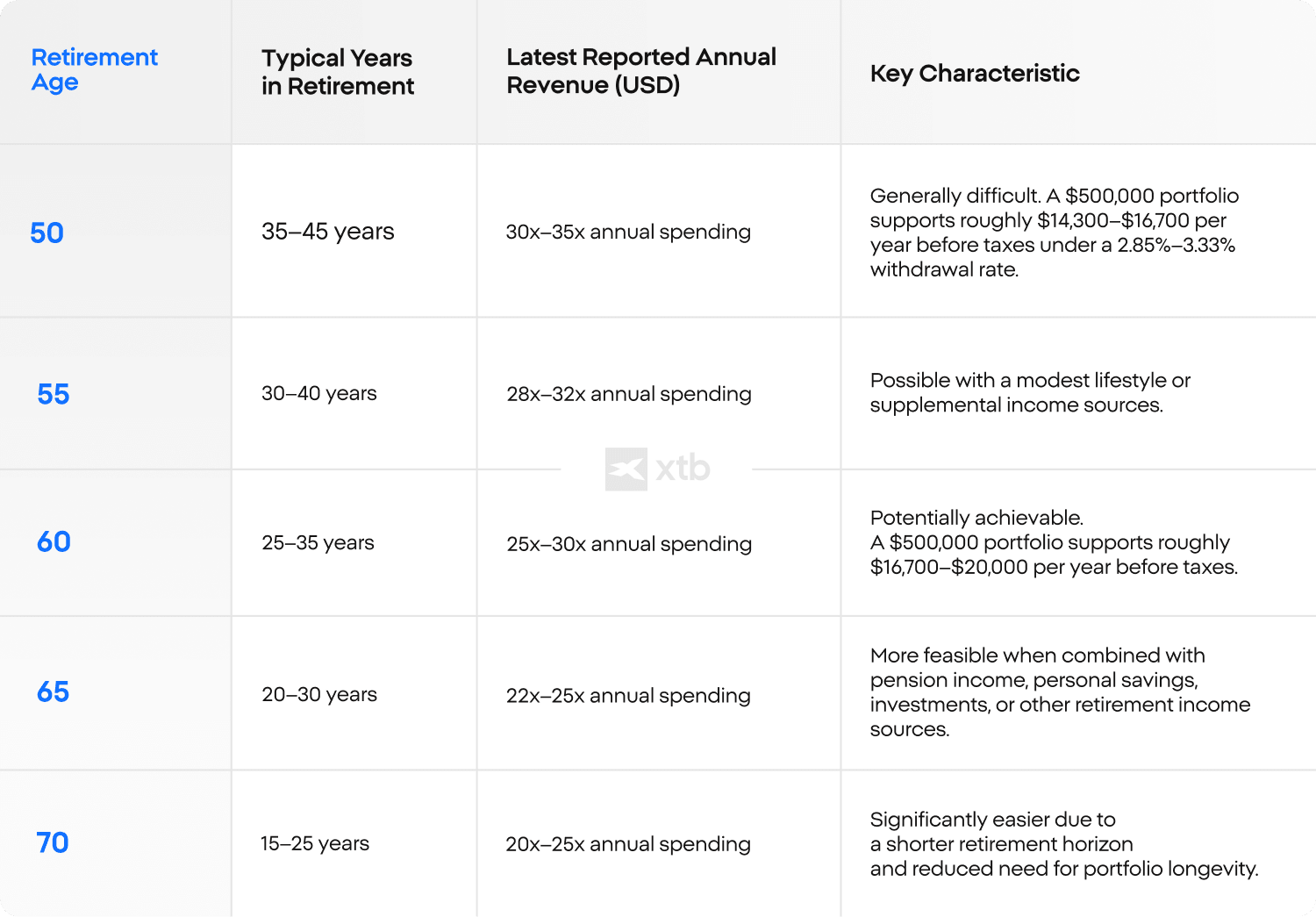
How much do you need to retire at 50, 60 or 65?
The earlier you transition into retirement, the more capital you need, simply because your money has to last for significantly more years. The target shifts upward when you plan to retire at 55 or 60 instead of 67.
Early retirement strategies, such as the FIRE (Financial Independence, Retire Early) movement, often require investors to accumulate 30 to 40 times their annual expenses, depending on their withdrawal rate, expected investment returns, and retirement horizon. Strategic approach regarding personal finance and financial future is an important part of FIRE philosophy.

FAQ
FAQ
There is no universal retirement number because the amount depends on your annual spending, retirement age, life expectancy, inflation, healthcare costs, taxes, and investment returns. Many financial planners use the 25x rule as a starting point, meaning someone who expects to spend $40,000 per year in retirement may target approximately $1 million in invested assets.
The 25x rule suggests accumulating a portfolio worth roughly 25 times your expected annual retirement expenses. It is based on the widely known 4% withdrawal rule, which assumes that withdrawing approximately 4% of a diversified portfolio annually may support retirement spending over several decades.
For some retirees, yes. For others, no. A $1 million portfolio could support approximately $35,000–$40,000 of annual withdrawals under common retirement-planning assumptions. Whether that amount is sufficient depends on your lifestyle, location, healthcare expenses, taxes, and other sources of retirement income.
Retiring with $500,000 is possible, but it usually requires lower annual spending, additional income sources, or retirement in a lower-cost area. Using a 4% withdrawal rate, a $500,000 portfolio would generate approximately $20,000 per year before taxes.
Retiring at 55 generally requires more savings than retiring at 65 because your portfolio may need to support 30 to 40 years of spending. Many early retirees target between 30x and 35x their annual expenses to provide a larger margin of safety.
Retirement at age 60 often requires a portfolio equal to approximately 25x–30x annual spending, depending on expected longevity and withdrawal assumptions. The exact amount varies according to personal circumstances and future market conditions.
The 4% rule is a retirement-planning guideline suggesting that retirees may be able to withdraw 4% of their portfolio during the first year of retirement and adjust future withdrawals for inflation. It is based on historical market data and should be viewed as a framework rather than a guarantee.
Inflation reduces purchasing power over time, meaning that the same amount of money will buy fewer goods and services in the future. Even moderate inflation can significantly increase the amount needed to fund retirement over a period of several decades.
Healthcare expenses vary by country and individual circumstances. In the United States, some estimates suggest a retired couple may need more than $300,000 throughout retirement to cover healthcare costs. In many European countries, public healthcare systems reduce out-of-pocket expenses, although long-term care costs can still be substantial.
Early retirement is achievable for some investors, but it usually requires a high savings rate, disciplined spending habits, and a long-term investment strategy. The earlier retirement begins, the larger the portfolio generally needs to be.
FIRE stands for Financial Independence, Retire Early. The concept focuses on saving and investing aggressively during working years to achieve financial independence well before traditional retirement age. Many FIRE followers aim to accumulate 30x–40x their annual expenses before leaving the workforce.
Many retirees keep a significant portion of their portfolio invested because retirement can last 20 to 40 years. Maintaining exposure to diversified investments may help offset inflation and support long-term portfolio sustainability, although investment risk remains.